


B2B marketing metrics are everywhere in your dashboards. You open your CRM, review your newsletter reports, and then examine your LinkedIn campaigns. The numbers are right there. Yet when it comes time to make a decision, whether to invest more, reallocate a budget, or halt an initiative, doubt sets in. You have the data. But do you really have clarity?
The 2026 High Growth Study Executive Summary, published by the Hinge Research Institute, highlights this paradox. Among companies posting more than 20% annual growth, 53.7% consider themselves poorly equipped to measure and leverage their marketing data, and only 11.9% believe they truly master their B2B marketing metrics. Among low-growth companies, 66.8% consider themselves weak, and barely 7.9% say they are truly competent.
In other words, even the highest-performing organizations acknowledge a weakness in their measurement systems.
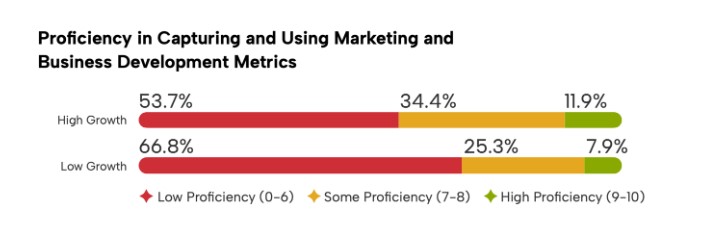
Source: Hinge Research Institute
On the contrary, they highlight a deeper issue: structure. In fact, it is not the data itself that is the problem. Rather, it is the unorganized accumulation of data and the lack of a decision-making framework that complicate the decision-making process.
B2B Marketing Metrics: What the Data Really Reveals
The study shows that the challenge doesn’t disappear as an organization grows. In fact, it intensifies. The more channels an organization adds, the more metrics it accumulates. Campaigns generate their own statistics, content produces its own signals, and, over time, new initiatives add additional layers of information.
Gradually, B2B marketing metrics multiply faster than the ability to prioritize them. As a result, your decision-making becomes more complex.
You may have experienced this. Traffic increases, but opportunities stagnate. Impressions rise, but sales slow down. Downloads remain stable, yet the quality of sales leads seems to decline. Teams debate, hypotheses pile up, and decisions are delayed.
In this context, data ends up creating noise, not because it’s wrong, but because it isn’t prioritized around a clear objective. Your teams know how to analyze, and your platforms know how to measure. But you still need a clear organizational structure to translate this information into action.
B2B Marketing Metrics: The Challenge Is Structural and Organizational
It’s not about intelligence or tools. Your B2B marketing metrics already exist. What’s missing is a coherent decision-making framework to bridge the gap between data and strategy.
First, in many organizations, metrics are chosen simply because they’re available, not because they inform strategic decisions. Dashboards are packed with data. Reports are detailed. Yet the strategic question remains unclear: what decision should this data inform?
Next, attribution adds a layer of complexity. A B2B customer’s journey often spans several months. They view content, attend events, return, compare options, and finally initiate a conversation. If these interactions aren’t consolidated, your B2B marketing metrics tell a fragmented story.
Finally, decision-making practices vary. The numbers are presented, sometimes with great seriousness. However, they are not always integrated into regular governance processes. The result: the data informs, but it does not automatically drive change.
Practical Guide: How to Structure Your B2B Marketing Metrics in 4 Steps
If the problem is structural, so is the solution. Here’s a simple method for turning your B2B marketing metrics into a decision-making tool, without adding to your daily workload.
Step 1: Clarify Your Strategic Priority
Before reviewing your dashboards, ask yourself a simple question: What is your current priority? Visibility, lead quality, accelerating the sales cycle, profitability. As long as this focus remains implicit, your metrics will remain scattered. When the priority is explicit, the selection of metrics becomes consistent. As a result, your metrics are no longer scattered. You stop measuring everything. You start measuring what truly supports your objective.
Step 2: Limit and prioritize your B2B marketing metrics
Sophistication does not come from quantity. Three to five B2B marketing metrics aligned with your priority are generally sufficient. This limitation reduces analytical overload. It facilitates dialogue between marketing and management. Above all, it imposes accountability: each metric must justify its existence; otherwise, it becomes noise.
Step 3: Consolidate Attribution and Customer Journeys
A B2B prospect doesn’t make a decision with a single click. They read, return, compare, sign up, and then browse. Without structured attribution in your CRM and a consistent connection between your channels, your B2B marketing metrics will remain incomplete. You then risk prioritizing what is visible at the expense of what is fundamental. Structuring attribution allows you to link visibility, engagement, and conversion within an integrated system. As a result, decisions are based on a more comprehensive view.
Step 4: Establish a decision-making discipline
B2B marketing metrics gain value when they influence a decision. Schedule a dedicated monthly meeting. Review strategic priorities. Examine trends. Distinguish between temporary fluctuations and lasting trends. Then, make clear decisions.
In fact, staying the course can be strategic. Reallocating resources may be necessary. Ending an ineffective initiative may become necessary. Consistency transforms measurement into governance.
B2B Marketing Metrics: Measure, Organize, Decide
A simple, consistent system of B2B marketing metrics will always have a greater impact than a complex dashboard that is rarely used. When measurement is integrated into governance, it reduces uncertainty, aligns teams, and builds organizational trust.
Data from the 2026 High Growth Study Executive Summary clearly shows this: even high-performing companies need to structure their approach. The difference lies not in the number of tools, but in strategic clarity and discipline.
At ExoB2B, we support B2B organizations in this structuring process to transform their B2B marketing metrics into a true decision-making lever. If you recognize this complexity in your own situation, that’s normal. And if you’d like to move from a descriptive approach to strategic governance, let’s start the conversation.
FAQ
Why do B2B marketing metrics create so much uncertainty?
Because there are often too many of them, they’re fragmented, and they’re poorly prioritized. Without clear strategic priorities and governance discipline, metrics pile up and complicate decision-making.
How many B2B marketing metrics should you track to be effective?
In most cases, three to five B2B marketing metrics aligned with a strategic priority are sufficient. Beyond that, you increase noise faster than clarity.
How do you link B2B marketing metrics to sales?
By structuring attribution in your CRM and connecting your key touchpoints. The goal is to link visibility, engagement, conversion, and business results.
How often should you analyze your B2B marketing metrics?
A monthly, decision-oriented review is a good frequency. It allows you to observe trends and then make decisions without getting bogged down in day-to-day reactions.
Are advanced analytics tools enough to improve performance?
No. Tools are necessary, but they do not replace a clear structure, strategic prioritization, and consistent decision-making discipline.