

Digital systems and artificial intelligence are gradually transforming the way brands are understood, compared, and perceived. This is leading to a new framework for brand perception in B2B marketing in the age of AI. Between companies and their markets, a new intermediary intelligence is emerging: that of response engines, AI Overviews, and systems that analyze, interpret, and restructure information even before a human interaction takes place.
A few weeks ago, I shared some thoughts on perception in B2B marketing based on a well-known quote by Al Ries and Jack Trout: “Marketing is a battle of perceptions.” A powerful idea, drawn from the book Positioning: The Battle for Your Mind, published in 1981.
My first reaction was simple: is this still true today? Not because the substance is debatable. But because everything surrounding the construction of this perception has changed profoundly since then. This reflection has continued to evolve.
Because what is changing today goes far beyond SEO, GEO, or the search engines themselves. These approaches are primarily technical responses to a much deeper transformation. What is really changing is the way market understanding is built.
For a long time, search engines were primarily used to find information. Today, with AI Overviews and answer engines, these systems are also beginning to interpret, synthesize, and restructure that information. And this understanding then influences perception.
This shift may seem subtle. Yet it is already transforming the way brands are understood in B2B marketing.
Why brand perception in B2B marketing is becoming an even more strategic issue
Perception has always played a central role in B2B marketing and branding. A company may possess solid expertise, offer high-quality services, and deliver tangible results, yet still fail to occupy a clear position in the minds of the market. Two companies may offer comparable technical expertise while being perceived in completely different ways.
This is precisely where B2B branding becomes strategic. It does not merely serve to improve an organization’s image. It also helps shape how that organization is understood, recognized, and evaluated within its market. From this perspective, Ries and Trout were right. Perception remains at the heart of marketing.
However, what is changing today is not the importance of perception. Rather, it is the dynamics that now shape its formation. For a long time, this perception was built primarily through relatively direct interactions: commercial exchanges, recommendations, references, content, and the experience with the company.
Today, a new form of intermediary intelligence is gradually emerging between brands and their markets. And this intelligence is already transforming the way companies are understood.
How Artificial Intelligence Is Changing Brand Perception in B2B Marketing
For a long time, brand perception in B2B marketing was shaped primarily through the brand itself, commercial interactions, business networks, and direct experience with the company.
Search engines and digital platforms were already influencing this dynamic. However, their role remained largely transactional. They were used primarily to find information and redirect users to external content.
Today, this dynamic has become much more complex.
Between brands and their markets, a new intermediary layer now influences how companies are perceived: answer engines, AI Overviews, and artificial intelligence.
For a long time, search was mainly about finding information. Now, systems are also beginning to interpret, prioritize, and contextualize this information to produce their own summaries.
Users now receive answers built from multiple pieces of content and signals analyzed by these systems. In other words, even before a user visits a website, part of their perception may already be influenced by the interpretation produced by these environments. Because a company can now be understood even before a human conversation takes place.
AI Overviews and Response Engines: A New Paradigm for Brand Perception in B2B Marketing
For years, search engines have primarily been used to organize access to available information and redirect users to external content. These systems now generate their own summaries based on the content they analyze. They establish connections between companies, interpret expert insights, and gradually build an understanding of the market.
Based on a query such as “B2B marketing and AI,” search engines are already beginning to reconstruct their own interpretation of the market from the content they analyze. In this example, the first two pieces of content included in the AI Overview come directly from analyses and content developed by ExoB2B, one of which was shared by Grenier aux nouvelles. This is a very concrete illustration of how systems select, interpret, and reuse certain content to build their own understanding of the market.
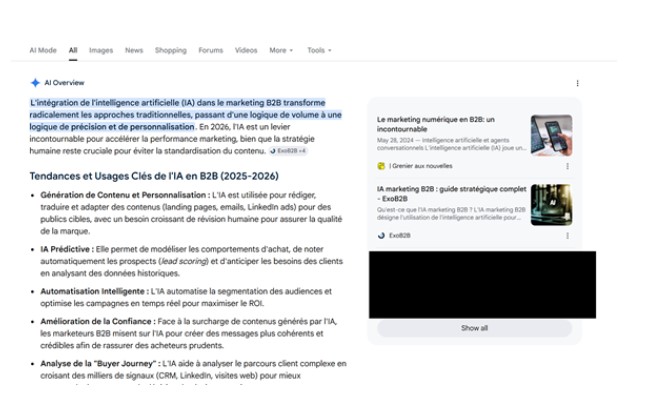
Example (In French) of an AI Overview generated from the query “B2B marketing and AI.” The engines are already beginning to interpret, synthesize, and organize an understanding of the market based on multiple content sources.
This understanding is sometimes imperfect. Yet it already influences what users will retain, understand, and perceive. In certain complex B2B environments, this reality becomes particularly significant. Systems may sometimes compare companies that are not actually competitors or oversimplify much more nuanced coopetitive dynamics.
Yet, even if imperfect, this understanding already influences perception. Because once systems begin to help build an understanding of the market, they also influence how companies are interpreted.
Content is becoming the foundation of understanding for brands in B2B marketing
This transformation is also profoundly changing the role of digital content. For a long time, companies viewed their content primarily as a tool for visibility, search engine optimization, or generating business opportunities. This approach still exists today. However, it is no longer sufficient to explain what is currently happening.
In reality, content now serves to feed systems that subsequently contribute to market understanding. Artificial intelligence now analyzes this content to interpret expertise, understand positioning, and establish relationships between organizations.
In this context, content no longer serves solely to inform humans. It also serves to feed the systems that contribute to market understanding. Thus, a company can produce a large amount of content without necessarily building a coherent understanding of its expertise, its role, or its value in its market.
Conversely, some organizations are gradually strengthening their authority because their content clearly defines their territory, their positioning, and their expertise. Content therefore becomes much more than a communication tool. It is gradually becoming an infrastructure for understanding.
The ExoB2B Model for Building Brand Perception in B2B Marketing
Brand perception in B2B marketing now relies on three forms of intelligence that constantly interact with one another.
For a long time, brand perception was shaped primarily by the relationship between the brand and the market. Today, a new intermediary layer is gradually emerging within this dynamic: that of digital systems, response engines, and artificial intelligence, which now play a role in organizing, interpreting, and restructuring information.
ExoB2B Model — Building Brand Perception in B2B Marketing
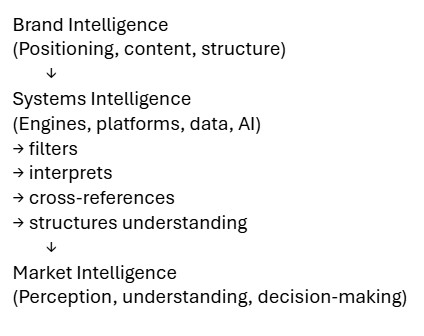
Brand Intelligence
Brand intelligence is based on the positioning, expertise, content, and authority built by the company. For a long time, this intelligence was primarily aimed at humans. Today, it must also be interpretable by systems.
In other words, content is no longer used solely for communication. It also serves to shape how the company is perceived in digital environments.
System Intelligence
System intelligence encompasses search engines, AI Overviews, platforms, and artificial intelligence systems that now play a role in organizing digital information.
Their role is no longer limited to relaying available information. Systems are now beginning to generate their own interpretation of the market based on the content, relationships, and signals they analyze.
And this understanding is gradually influencing how companies are perceived.
Market Intelligence
Market intelligence remains deeply human. It is still based on relationships, networks, references, communities, and lived experiences.
However, this market intelligence is now influenced by a new systemic layer that helps organize and interpret information even before many interactions take place.
Thus, brand perception in B2B marketing is no longer built solely through direct human interactions. It is also shaped by the systems that now help to foster an understanding of the market.
The new challenge for brands in B2B marketing: making themselves understandable
In recent months, discussions about SEO, GEO, AEO, and response engines have been taking up an increasingly prominent place in marketing conversations. For a long time, B2B brands have primarily sought to be visible, credible, and distinctive in their markets. Today, the real challenge is gradually becoming: being properly understood.
A company can now be visible while still being misinterpreted by the systems that analyze its content, positioning, and relationships within its ecosystem. Companies will therefore need to learn to clarify, structure, and connect their expertise, positioning, and content in a much deeper way.
Because today, systems no longer simply read content. They analyze it to build a representation of the market
Toward a New Approach to Understanding B2B Markets
What is changing likely goes beyond SEO tools, platforms, or tactics. We may be witnessing a much deeper transformation in the way markets understand businesses. The role of content is evolving. However, digital assets are evolving as well. More broadly, it is the dynamics of market perception and understanding that are beginning to shift.
Today, however, a new responsibility seems to be gradually emerging: becoming understandable in environments where systems actively participate in shaping perception. In other words, companies will no longer need to focus solely on their visibility or positioning. They will also need to learn how to structure their expertise in a sufficiently coherent manner to be correctly interpreted by the systems that now help organize information.
And this transformation could redefine the way markets understand themselves much more profoundly than we realize. We are likely only at the beginning. Would you like to better understand how your company is interpreted by search engines and artificial intelligence systems? Contact ExoB2B to start the conversation.
FAQ
Why Are AI Overviews Changing Visibility for B2B Companies?
AI Overviews now generate summaries based on content analyzed by the systems. This approach directly influences how companies are discovered, understood, and perceived in digital environments.
What is the difference between SEO, GEO, and response engines?
SEO and GEO primarily involve optimization approaches. However, the current shift goes far beyond these techniques. Response engines and artificial intelligence now play a role in interpreting and restructuring information to build an understanding of the market.
Why do B2B brands need to become understandable?
Because digital systems now help interpret companies even before a user directly views their content. Visibility alone is no longer enough. Companies must also be properly understood.