

You’re investing in AI-driven SEO. You’re enriching your service pages, publishing case studies, and documenting your expertise. A few months later, a question arises: Are these efforts paying off? Measuring GEO in B2B involves answering this question with data, but above all, understanding what the data tells you and what you could improve.
Measurement tools are evolving and gradually providing more information on visibility in AI search engines. However, having new data doesn’t automatically mean you know how to interpret it. A dashboard may display encouraging numbers without clearly indicating what decisions to make.
If you’re in charge of marketing for a B2B company, you’re probably familiar with this challenge. It’s not enough to know whether your company appears in AI search engine results. You also need to verify whether those results associate your company with the expertise your buyers are seeking and the issues that influence their decisions. At ExoB2B, we believe that the true value of GEO measurement lies in its ability to inform your marketing decisions, far beyond the numbers displayed.
Measuring GEO in B2B Starts with the Right Questions
Avant de choisir vos indicateurs, vous devez déterminer ce que vous souhaitez observer. Votre entreprise To choose your metrics, you need to determine what you want to track. Does your company want to be recognized for a particular area of expertise? Are you looking to boost your visibility in certain markets or to better understand your position in the responses generated by AI?
To measure GEO in B2B marketing, the questions you track must reflect your markets and your buyers’ concerns. It is therefore not enough to simply check whether your company appears in the AI’s responses.
Let’s take the example of a Quebec-based company specializing in the maintenance and modernization of industrial electrical equipment. Its potential customers include plant managers, maintenance supervisors, and engineers. Their searches may focus on technical problems, possible solutions, or specialized suppliers.
Here are three representative types of questions:
- Understanding a problem: “How do I assess the condition of an aging transformer?”
- Comparing solutions: “Should I modernize or replace industrial electrical equipment?”
- Identifying suppliers: “Which companies offer high-voltage equipment modernization services in Quebec?”
These questions do not correspond to the same stage of the buying journey. However, they can all help raise awareness of a company and establish its relevance to buyers.
The goal is not to include every possible phrasing. Rather, it is to select questions that are representative of your markets’ needs and your business priorities. This selection provides context for the metrics you will analyze next.
The Five Metrics for Measuring GEO in B2B
No single metric can, on its own, capture your GEO performance. To get a useful picture, you need to examine several complementary dimensions: your presence in responses, the representation of your expertise, interactions with your content, and the business opportunities that may arise from them.
However, these metrics have limitations. Not all AI engines present their results in the same way, and their responses may vary depending on phrasing and the observation period. The following five metrics are therefore benchmarks, not a universal measurement system.
1. The attendance rate for priority issues
This metric measures the proportion of responses in which your company appears among the questions you’ve chosen to track.
Suppose you’re analyzing 20 questions in ChatGPT. If your company appears in six responses, its presence rate is 30% for this set of questions.
Presence rate = (responses mentioning your company ÷ responses analyzed) × 100
This result gives you an initial overview of your visibility. However, it does not represent your overall visibility in AI engines, since it is derived from a specific sample.
You should also look at where your company appears and where it is absent. A presence in general questions may be less relevant than a mention in a technical need directly related to your services.
2. Citations and the pages that receive them
Certain tools now allow you to see which pages AI engines cite in their responses. Bing Webmaster Tools, in particular, provides data on content citations in certain AI experiments.
This information can help you identify the content that these systems use as references. You might find that a case study on the modernization of a transformer is being cited, while your corresponding services page receives few citations.
However, not all citations are equally valuable. A frequently cited page on a secondary topic does not necessarily contribute as much to your search rankings as content associated with strategic expertise.
The analysis must therefore focus as much on the nature of the cited content as on its frequency. It must also take into account the coverage limitations inherent in the available tools.
3. The quality of the displayed information
Your company may appear in an AI-generated response without the response accurately reflecting its expertise. The AI may mention your brand but provide an incomplete description of your services or emphasize secondary activities.
This metric therefore requires a qualitative review of the responses. You want to determine whether the information presented truly aligns with your positioning.
| Criteria | Question to consider |
|---|---|
| Accruacy | Are your activities described correctly? |
| Expertise | Are your key skills recognized? |
| Relevance | Does the response address the stated need? |
| Differentiation | Are your unique qualities mentioned? |
Let’s take another look at our company, which specializes in electrical equipment. If an AI model describes it solely as a provider of general maintenance services, it risks overlooking its expertise in the modernization of high-voltage equipment.
The information is there, but the representation remains incomplete. For a B2B company whose services require specialized skills, this distinction can influence buyers’ perceptions.
4. Visits and interactions generated by AI
Your visibility in AI search engines can also drive traffic to your website. Google Analytics 4 (GA4) allows you to track some of these visits when they come from identifiable sources.
In particular, you can examine the pages viewed, interactions made, and forms filled out following a visit attributable to an AI tool.
However, this data remains incomplete. Some interactions with Google’s AI features appear in standard search data, while other user journeys do not clearly identify their origin.
It would therefore be risky to rely solely on traffic attributed to AI to assess your GEO performance. This metric provides additional insight, but it does not measure all interactions between shoppers and AI search engines.
5. Business Opportunities Related to AI
For a B2B company, GEO analytics becomes more valuable when it can be linked to sales opportunities. This does not mean that a mention directly leads to a request for a quote or a sale.
The B2B buying journey often involves multiple people, various sources of information, and numerous interactions before the first contact with a supplier.
Your marketing and sales teams can, however, gather useful insights. For example, a potential customer might mention that they discovered your company while searching on ChatGPT. This information can enrich your CRM data and help you better understand certain customer journeys.
However, you should avoid automatically attributing every sales opportunity to AI. The goal is rather to recognize its potential contribution among the various touchpoints that influence purchasing decisions.
What tools should be used in measuring GEO in B2B?
The available tools cover various aspects of AI visibility in B2B. None of them currently provide a comprehensive and fully comparable overview of your presence across all search engines.
| Tool | What it allows us to observe |
|---|---|
| Google Search Console | Visibility in Google, including certain interactions with its AI features. |
| Bing Webmaster Tools | Certain content citations, the relevant pages, and related topics. |
| Google Analytics 4 | Identifiable visits from AI tools and interactions on your site. |
| Tests in AI search engines | Your company’s presence and the quality of responses to targeted questions. |
| CRM | Sales information that helps align certain opportunities with search journeys. |
These tools do not all measure the same thing. A Google search result, a citation in an AI response, and a brand mention are not comparable units.
You should therefore avoid adding them together to produce an overall score that would give a misleading impression of accuracy. Their value lies instead in the complementary nature of the observations.
From the Dashboard to GEO Diagnostics: Understand Before Taking Action
A dashboard can show you that your company appears regularly in AI responses. However, this information doesn’t necessarily explain why certain topics generate more visibility than others.
Let’s take another look at our company, which specializes in industrial electrical equipment. It has a satisfactory presence for maintenance-related queries, but rarely appears when a buyer is searching for modernization solutions.
Two companies may have comparable visibility rates without enjoying the same level of recognition among their buyers. If the first company appears mainly in discussions of general topics and the second in discussions of technical needs directly related to its services, their results do not necessarily have the same commercial value. The frequency of mentions is therefore not enough to establish the strategic relevance of this visibility.
Several factors may explain these discrepancies. Service pages may present certain areas of expertise in overly general terms. Case studies may not sufficiently document relevant achievements. It is also possible that the topics being tracked do not exactly match buyers’ concerns.
The analysis can also reveal which companies regularly appear in AI responses on priority topics. This insight offers valuable competitive intelligence, provided you view it within the context of your markets and areas of expertise.
However, these findings do not automatically justify the creation of new content. First, you need to understand whether the issue relates to visibility, the clarity of your positioning, the documentation of your expertise, or the relevance of the topics you’re tracking.
This is precisely where the GEO assessment proves its true value. At ExoB2B, we address these observations by linking them to the company’s marketing strategy, markets, and business objectives. This approach allows us to distinguish between symptoms and underlying issues before determining priorities.
Link the metrics to the various stages of AI visibility
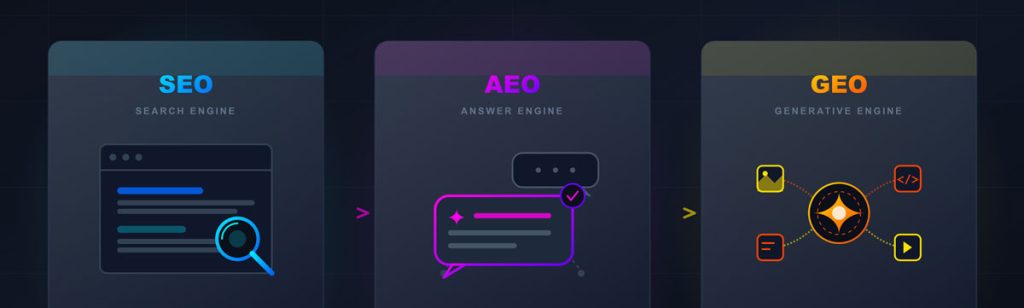
GEO indicators do not all measure the same type of progress. Some are used to verify whether a company is present, while others help determine how it is represented and whether that visibility contributes to its reputation.
| Passage | What it allows us to observe |
|---|---|
| Being found | The company’s presence in responses to priority questions. |
| Being understood | The accuracy of its portrayal and recognition of its expertise. |
| Being Cited | The content and pages used as sources. |
| Being Recommended | The company’s presence in comparisons and business research contexts. |
| Being Selected | Interactions, business opportunities, and signs of influence on decision-making. |
A company may show improvement on a metric without necessarily moving on to the next stage. That is why the assessment must focus as much on the quality and relevance of the company’s presence as on its frequency.
Turning GEO Metrics into Marketing Decisions
Metrics are useful when they help you ask better questions. Rather than reacting immediately to every fluctuation, you can seek to understand what the data reveals about your online presence and how AI engines showcase your expertise.
| Observation | Strategic Question |
|---|---|
| Limited presence on a priority topic | Does the content address buyers’ actual needs? |
| Quotes concentrated on a single page | Is the expertise sufficiently documented elsewhere on the site? |
| Expertise poorly described | Are the positioning and services presented clearly? |
| Non-committal AI visits | Does the content viewed meet expectations? |
| Increased visibility without inquiries | Do the tracked topics align with business priorities? |
These questions do not constitute a comprehensive diagnostic method. Rather, they illustrate why data interpretation must precede any interventions.
A low presence can stem from several causes. Similarly, an increase in mentions does not guarantee that your company is becoming more relevant to the buyers who matter most to it.
The role of analysis is therefore to put these metrics into context. This will help you better understand the gaps between your desired positioning, the available content, and how your company is represented in AI responses.
Measuring GEO in B2B Without Adding Unnecessary Metrics
As the number of tools increases, the number of metrics can quickly follow suit. You then run the risk of spending more time generating reports than understanding what they mean.
To ensure your metrics remain useful, focus on information that addresses three key questions: where does your company appear or remain absent in the data; what areas of expertise do AI engines recognize; and what connections can you draw to your marketing and sales goals?
This approach does not seek to artificially reduce the complexity of GEO. Rather, it aims to prevent the sheer volume of data from overshadowing its relevance.
Results must also be viewed with sufficient perspective. A one-off variation in an AI engine’s responses does not necessarily constitute a lasting trend.
At ExoB2B, measuring GEO is primarily a way to make better decisions
GEO should not operate independently of your B2B marketing strategy. It is part of a broader framework that includes organic search, content strategy, positioning, and market knowledge.
This perspective ties into a broader discussion about the role of artificial intelligence in B2B marketing. Visibility in AI-powered search engines is one aspect of this evolution, but it does not replace an understanding of buyers or the company’s strategic decisions.
For this reason, we place as much importance on interpreting results as we do on collecting them. A metric may reveal an interesting discrepancy, but you must understand that discrepancy before deciding where to invest.
“A good GEO dashboard doesn’t just collect numbers. It guides decisions.”
This conviction sums up our approach. Measurement should help you better understand how your expertise circulates in digital environments and identify the issues that deserve strategic attention.
Turning GEO into a Marketing Management Tool
Measuring GEO in B2B is gradually becoming more accessible. However, visibility data only truly delivers value when it informs your marketing decisions. An additional mention in an AI engine does not guarantee more sales leads, just as a citation does not automatically mean that your buyers better understand your expertise.
For your company, the challenge lies in understanding the gaps between the areas of expertise you want to be recognized for and how AI engines present them. This analysis must be integrated into your B2B marketing strategy, alongside SEO, positioning, and market intelligence. It helps you better target your investments rather than simply accumulating more metrics.
Do you have data on your visibility in AI search engines but aren’t sure what conclusions to draw from it? ExoB2B helps you conduct a GEO analysis, identify your priorities, and integrate these actions into your B2B marketing strategy.
To give you food for thought
- AI visibility in B2B: simply being mentioned is not enough to be chosen
- How can your content influence B2B buying decisions?
- GEO: Optimization for generative engines explained
Related Service
AI and GEO B2B SEO: How to Be Visible on Google and AI Search Engines
FAQ
How can you measure GEO in B2B without specialized software?
You can start by tracking a limited set of questions representative of your markets across various AI engines. This manual monitoring allows you to assess your presence and the quality of the responses, even if it does not provide a comprehensive measurement.
Which GEO metrics should you prioritize?
Your presence rate on strategic questions, content citations, and the quality of how your expertise is represented are a good starting point. Identifiable visits and business insights can then round out your analysis.
Measuring GEO in B2B: How often should you analyze your GEO results?
Regular monitoring allows you to identify trends without reacting to every isolated fluctuation. The frequency should take into account your markets, your objectives, and the limitations of the available data.
How can you tell if a GEO optimization is working?
You can track changes in your presence, citations, and the quality of responses on the relevant topics. However, progress alone does not prove that a specific action is the cause.